
Drain unblocking specialist
Drain unblocking company with a 24/7 service
You don't usually call a drain unblocking company until the water has stopped draining away, and by then all you want is someone who can find the cause quickly. Afvoer Ontstoppen deals with blockages and nothing else, from a toilet that's full to the rim to a sewer blocked beneath the garden. You can reach us by phone 24/7, including at night, at weekends and on public holidays. You'll get a price estimate up front, and an engineer with the right equipment will come out as soon as possible.
Signs of a blockage
If you notice one or more of these signs, your drain is probably blocked, or partly blocked. Not sure? Call us for advice.
- Several drains slow to empty at the same time
- Gurgling or glugging from the toilet or a drain
- Sewage smell indoors even though every trap holds water
- Water coming up through the lowest shower drain
- Inspection chamber in the garden full of water
- A blockage that keeps returning after a few weeks
How we unblock it
-
Initial phone call
You tell us which drains are giving trouble, since when, and what you've already tried. Based on that, we work out what equipment is needed and give you a price estimate.
-
Locating the cause
The engineer first checks which drains still work and, where possible, opens an inspection chamber or rodding eye. That tells them whether the blockage is in a branch pipe, the soil stack or the underground drain.
-
Choosing the right technique
Depending on the location and type of pipe, we use a hand-held drain snake, an electric drain machine or a high-pressure jetter. If we're unsure about the pipe's condition, we check it with a camera.
-
Final check and advice
We flush the pipe through and check that every drain is running freely again. Then we explain what caused the blockage and how you can stop it happening again.
How your drainage system works
Once you know how waste water flows through a house, it's easier to work out where a blockage is. Every fixture has its own trap with a water seal that keeps sewer smells out. Beyond the traps, narrow branch pipes lead to a soil stack or straight into the underground drain beneath the ground floor. The underground drain runs to the property boundary, where it joins the municipal sewer via the sewer connection. As a drain unblocking company, we begin every call with the same question: which drains are still working? The answer usually tells us which part of the system to look in.
Branch pipes and traps
The pipes from the washbasin, kitchen sink and shower are narrow, often 32, 40 or 50 millimetres in diameter. Hair, soap residue and grease soon get caught in them, especially at bends and in a trap that rarely gets unscrewed. A blockage in a branch pipe affects only one fixture. That's a nuisance, but rarely an emergency.
Soil stacks in blocks of flats
In a block of flats or an upstairs flat, the drains from several floors come together in a vertical soil stack. At the bottom, where the stack turns into the horizontal underground drain, there's a bend, and that's where everything coming down from above collects. If that bend gets blocked, the residents on the ground floor are the first to notice: their shower or toilet fills up with their neighbours' waste water.
Underground drain and sewer connection
In a modern home, the underground drain is often 110 or 125 millimetres in diameter and slopes gently towards the street. If part of the pipe subsides, or roots grow in through a loose joint, waste water sits in the pipe and debris builds up. Defects like these can't be seen from the outside, but they're easy to find with a camera.
Signs the blockage is deeper in the system
A single slow washbasin is often something you can sort out yourself. It's a different story when several drains are playing up at the same time. Look out for these signs:
- the toilet gurgles when the washing machine pumps out or the shower is running;
- water comes up through the shower drain or floor drain on the lowest floor;
- the inspection chamber in the garden or at the front of the house is full;
- you can smell sewage even though all the traps are full of water;
- a blockage you've cleared comes back within a few weeks.
Water coming up at the lowest point in the house is known as backflow. The waste water has nowhere to go, so it escapes through the first opening that sits lower than the water level in the pipe. A blocked underground drain can cause this, but so can an overloaded sewer in the street during a heavy downpour. In the latter case, a non-return valve in the pipe may be the answer, and we're happy to look into that with you.
Trying it yourself first? Here's what's safe
If only one fixture is blocked, by all means have a go yourself. A plunger works well on a washbasin, kitchen sink or toilet; just cover any overflow with a wet cloth so the pressure doesn't escape. Put a bucket under the trap, unscrew it and rinse it clean. Hot but not boiling water with a squirt of washing-up liquid can loosen a grease blockage that's just starting to form.
We advise against harsh caustic or acid-based drain cleaners. They won't dissolve a blockage of wipes or kitchen roll, they can damage rubber seals and older pipes, and they sit in the pipe if the water isn't draining away. If an engineer has to come out after all, they're left working in a pipe full of corrosive liquid. So always let us know if you've already used one.
Stop and call us if several drains are blocked at once, if water is coming up at the lowest point, or if two attempts with a plunger and a clean trap get you nowhere. Carrying on flushing at that point only makes things worse, and at worst you'll end up with water all over the floor.
The equipment our drain unblocking company uses
A good drain unblocking company matches the technique to the pipe, not the other way round. A narrow 32-millimetre branch pipe needs different tools from a 110-millimetre underground drain that runs twenty metres to the street. With a DIY-store drain snake, usually a few metres long, you'll rarely reach the blockage in a drain like that.
Hand-held drain snake and electric drain machine
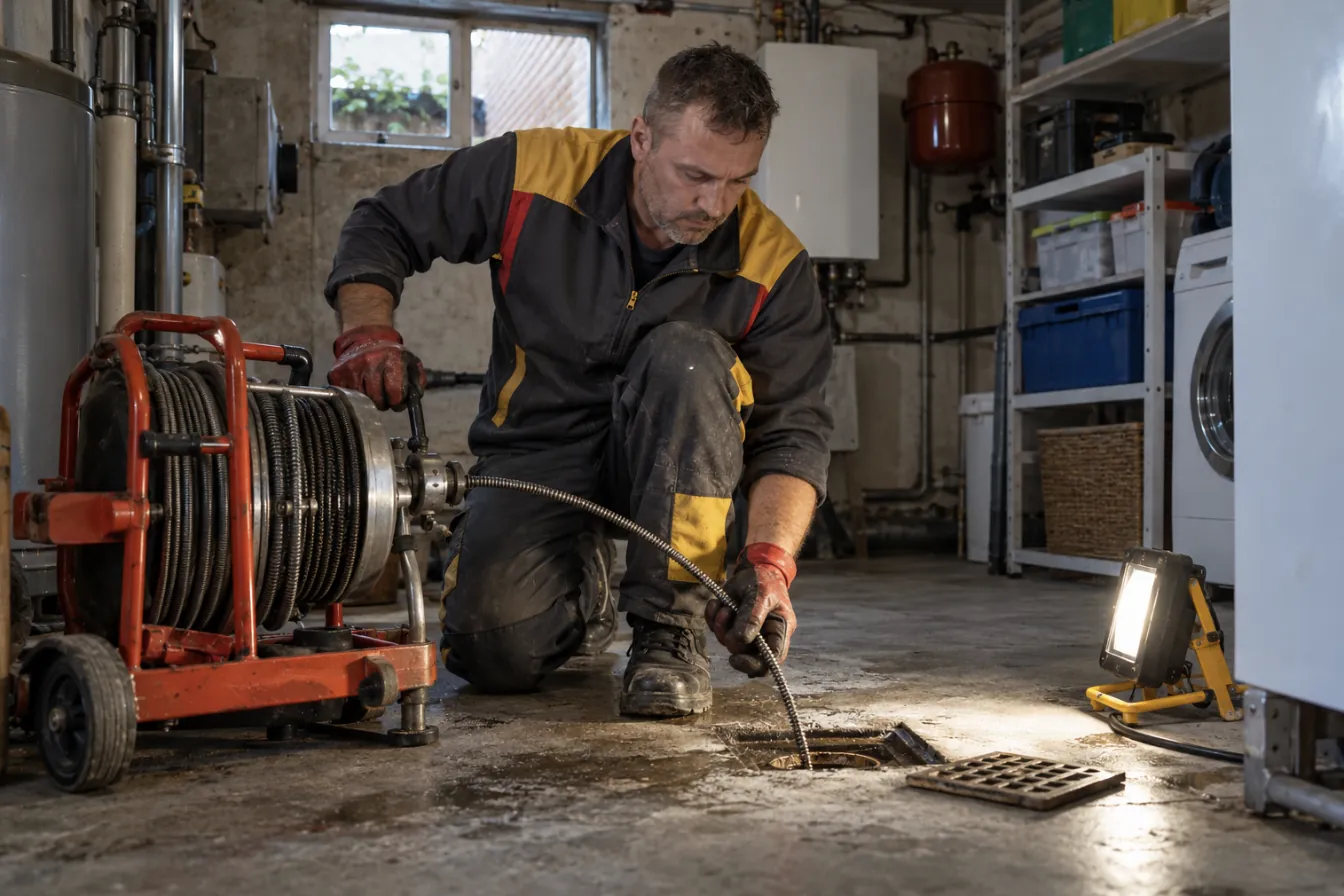
For short runs and narrow pipes we use a hand-held drain snake: a flexible coil that we turn as we feed it into the pipe until it hits the blockage, which it then breaks up or pulls out. For longer distances and stubborn blockages we bring in an electric drain machine with interchangeable heads that cut through grease and dirt.
High-pressure jetting
A drain snake punches a hole through the blockage but often leaves deposits on the pipe wall. So for grease, silt or root debris, we clean the pipe with a high-pressure jetter. A nozzle with backward-facing jets pulls itself along the pipe and scours the wall clean along its full length. Find out more on our sewer cleaning page.
Camera inspection
If a blockage keeps coming back or we suspect damage, we send a camera through the pipe. You see on screen what the engineer sees: a sagging section, a crack, roots or a displaced joint. A transmitter in the camera head lets us pinpoint the spot from above ground, so there's no unnecessary digging. There's more about this on our drain camera inspection page.
Sewer unblocking: your property or the municipality's?
When a sewer needs unblocking, the question of who is responsible often comes up. Broadly speaking, the owner looks after the drains inside the building and the pipe on their own property, while the municipality (gemeente) is responsible for the sewer under the public road. Exactly where that boundary lies varies from one municipality to another; it's often the property boundary or an inspection chamber located on it.
If you rent, report a blockage in the underground drain to your landlord. In a block of flats, a shared soil stack is usually a matter for the owners' association (VvE). We clear the immediate blockage and record where it was, so you can take it up with the right people. If you're having the sewer unblocked in a rented home, check with your landlord first, where possible, about who pays the bill.
Rates and out-of-hours emergencies
Our engineers unblock drains from €129, call-out charge not included. Outside office hours, which includes weekends and public holidays, we charge an out-of-hours rate. For work that takes longer, such as cleaning a long underground drain or a full inspection with a written report, you can ask for a quote in advance.
Whatever the time, you'll get a price estimate over the phone first, and the engineer only sets off once you've agreed. Our drain unblocking service answers the phone even at three in the morning. The engineer is usually with you within the hour, depending on how busy we are and how far they have to travel. Until they arrive, use as little water as possible and switch off the washing machine and dishwasher.
24/7 drain unblocking doesn't mean every job has to be done in the middle of the night. If the upstairs toilet still works and only the washbasin is slow, it can often wait until the next morning at the normal rate. We'll be straight with you when it's safe to wait.
Preventing repeat blockages
Most blockages are caused by what ends up in the drain. Here's what you can control yourself:
- let frying and cooking fat cool in an old jar or bottle and put it in the general waste instead of pouring it down the kitchen sink;
- only flush toilet paper; wet wipes, even those labelled flushable, barely break down in the pipe;
- put a hair catcher in the shower and empty it regularly;
- unscrew the kitchen and washbasin traps every now and then to clean them;
- if you're unsure about older garden drains with trees nearby, have them inspected.
After every job, the engineer tells you what they found in your pipe. That explanation is often the best prevention there is: once you know it was grease, you'll handle it differently in future. An unblocking service that just removes the blockage and leaves only solves half the problem.
Areas our drain unblocking company covers
We work throughout the Netherlands, from Groningen and Zwolle to Rotterdam and Eindhoven. Our locations page lists a selection of cities, each with its own page. If it's mainly your toilet that's blocked, our page on toilet unblocking explains more.
Dealing with a blockage right now? Call 085 333 4698 and tell us what's going on. We'll help you work out the best way forward straight away.
Rates per job
Before the engineer sets off, we'll give you a price estimate. If more turns out to be needed on site, we'll discuss it with you first.
Call-out charge not included.
Drain unblocking service: questions and answers
What's the difference between a drain unblocking company and an ordinary plumber?
A plumber does a bit of everything, from taps to heating pipes. We deal only with drains and sewers. That's why our engineers come equipped as standard with things a general plumber doesn't always bring, such as an electric drain machine, a high-pressure jetter for pipes and an inspection camera. For a leak or a new tap, you're better off calling a plumber.
Do you come out at night or on Sundays?
Yes. You can reach us by phone day and night, including on Sundays and public holidays. Outside office hours an out-of-hours rate applies, and we'll tell you what it is before the engineer sets off. If the job can safely wait until the next morning, we'll be honest about it, so you can choose between immediate help and a daytime visit.
Who pays for a blockage in the sewer under the street?
That depends on where the blockage is. Generally speaking, the owner is responsible for the drains on their own property and the municipality for the section under the public road. Exactly where that boundary lies varies from one municipality to another. A camera inspection lets us show you where the problem is, so you can take it up with the municipality or your landlord.
How much does it cost to call in a drain unblocking company?
Unblocking a drain costs from €129, call-out charge not included. In the evening, at night, at weekends and on public holidays we charge an out-of-hours rate. For bigger jobs, such as cleaning a long underground drain or a full camera inspection, you can ask for a quote. Whatever the job, you'll get a price estimate first, so you can decide whether to have the engineer come out.
How can I stop the same blockage coming back?
First you need to find out why the pipe keeps blocking up. Often it's grease, wipes or hair, but a sagging pipe or too little fall can also be to blame. For recurring problems we recommend a camera inspection. That will tell you whether changing a few habits is enough, or whether a section of pipe needs repairing.
Still have a question? Have a look in our FAQ section.
More drain unblocking services
-
Toilet unblocking
The blockage could be in the bowl, the soil stack or the underground drain. We find out where the toilet is blocked first, then clear the drain thoroughly.
-
Kitchen sink unblocking
Grease, coffee grounds and food scraps slowly build up in the kitchen waste pipe until it blocks. We clear the sink and the pipe behind it, and flush it through with high-pressure jetting where needed.
-
Washbasin unblocking
Hair and soap residue build up in the washbasin trap and waste pipe. We clean both and find out why the basin was slow to drain.
-
Shower drain unblocking
Hair and soap scum build up in the shower drain and the pipe below it. We remove the blockage and clean the pipe along its full length.
-
Sewer cleaning
Grease, silt and root intrusion gradually narrow a sewer pipe. Our high-pressure sewer cleaning flushes the whole length of the pipe clean, and we show you the cause.
-
Drain camera inspection
Recurring blockages always have a cause. A drain camera inspection lets you see live whether roots, subsidence or a broken pipe is to blame.
-
Downpipe unblocking
Leaves, moss and sand block the gutter, the downpipe or the pipe underground. We clear the whole route, so rainwater drains away again instead of running down your walls.
Blocked drain? We'll sort it.
Call now for professional drain unblocking. Price estimate up front, available 24/7, throughout the Netherlands.