
Drain unblocking specialist
Sewer cleaning and sewer unblocking
Sewer cleaning is the answer when a blockage keeps coming back, when several drains slow down at once, or when the sewer under your garden hasn't been cleaned for years. Afvoer Ontstoppen jets the pipe clean along its full length, from the house to the property boundary. That clears out grease, silt and roots, rather than just punching a hole through the blockage. Call us 24/7 and you'll get a price estimate up front.
Signs of a blockage
If you notice one or more of these signs, your drain is probably blocked, or partly blocked. Not sure? Call us for advice.
- Several drains in the house slow down at once
- The toilet gurgles when the shower or washing machine is on
- A sewer smell in the garden, crawl space or near the inspection chamber
- A high water level in the inspection chamber
- The same blockage is back within a few months
- Water coming up through the lowest drain in the house
How we unblock it
-
Finding the cause
The engineer opens the inspection chamber and checks the water level. That shows whether the blockage is between the house and the chamber, or further along towards the street.
-
Breaking through and flushing
A nozzle with rear-facing, angled jets drives itself along the pipe, breaks up the blockage and washes grease and silt out of the entire length.
-
Cutting out roots
For roots or hard grease crusts, the engineer switches to a root cutter or chain flail, which knocks roots and deposits off the pipe wall. The pipe is then flushed through again.
-
Final check and advice
Finally we check the flow, with the camera if needed. We then tell you what was in the pipe and how to stop the sewer silting up again.
Unblocking or sewer cleaning: what's the difference?
Unblocking and sewer cleaning sound similar, but they're two different jobs. To unblock a drain, the engineer opens up a passage so the water can run away again. Sewer cleaning goes further: it cleans the entire inside of the pipe, removing not just the blockage but also the deposits on the pipe wall where the next one is already forming.
The difference shows most in pipes that have been in use for years. Grease and silt can narrow a 110 or 125 millimetre underground drain until only a thin channel is left. A drain snake will poke a hole through it, but within a few months the pipe is blocked again. High-pressure sewer cleaning strips that layer from the whole circumference, restoring the pipe to its original bore.
What builds up in a sewer
Kitchen grease
Hot frying fat and gravy seem perfectly liquid as they go down the sink. In the cool underground drain, though, they solidify and cling to the pipe wall, and everything that passes sticks to them in turn. After a few years there's a hard, yellow crust inside the pipe, often thickest in the first few metres after the kitchen connection. If your problems started with a slow kitchen drain, see our page on kitchen sink unblocking as well.
Root intrusion in older pipes
Many older homes still have clay or concrete pipes with socket joints. Over time, small gaps open up at those joints, and tree roots never fail to find them: inside a sewer pipe it's damp and full of nutrients. A hair-thin root works its way in and grows into a dense mat that catches toilet paper and grease. We mostly see root intrusion at properties with trees, hedges or large shrubs above or beside the pipe.
Subsidence and sand
Many homes are built on clay or peat, and that ground slowly settles. As a result, a pipe that was once neatly laid to a fall can sag at one point. Water always stands in a dip like that, and sand and silt settle in it. A shifted joint also forms a ridge that dirt gets caught behind. Sand often gets in through downpipes connected to the sewer, or through a crack in the pipe.
What doesn't belong in the sewer
Wet wipes, kitchen roll, tampons, cat litter and cotton buds don't break down the way toilet paper does. They snag on a ridge or a root and form a blockage that keeps growing. Building waste, such as cement residue after a renovation, can also narrow a pipe without anyone noticing.
Indoor drains, outdoor drains and the property boundary
A home's drainage has two main parts. The indoor drainage runs in and under the house: the waste pipes, the soil stacks and the underground drain beneath the floor. From there the pipe runs outside, under the garden or pavement, to the municipal sewer in the street.
As a general rule, anything on your own property is your responsibility as the owner, while the part under public land usually falls to the municipality. Exactly where the line is drawn varies between municipalities; often it's the property boundary or an inspection chamber just beyond it. If you rent, the landlord normally deals with the sewer, and in a block of flats it's often the VvE (owners' association).
When there's a blockage, that distinction matters. If the blockage is on the street side, it may be a matter for the municipality. A camera inspection of the sewer shows how far from the inspection chamber the problem is, so you know whose door to knock on.
Check the inspection chamber yourself first
A dirty sewer usually gives you some warning: several drains slow down at once, the toilet gurgles when the shower is running, and there's a sewer smell around the inspection chamber in the garden. If the sewer is completely blocked, nothing drains away anywhere and the water comes up at the lowest point in the house. A sewer blockage like that first has to be cleared, and then the pipe needs a thorough clean. To find out where the problem is, start by looking in the chamber.
Many homes have an inspection chamber with a round or square cover next to the outside wall or at the edge of the garden. Wearing work gloves, you can safely lift the cover and see what's going on:
- The chamber is full of water. The blockage is further along, towards the street.
- The chamber is empty, but nothing drains away indoors. The blockage is between the house and the chamber.
- The water is flowing, but slowly and with a lot of floating debris. The pipe has narrowed and is due for a clean.
Don't climb into the chamber, don't put your hands in the sewage, and keep children and pets well away. Put the cover back securely afterwards. And don't pour chemical drain unblocker into the chamber or the drains. In an underground drain it gets so diluted that it does very little, yet the corrosive liquid is still there in the water the engineer will have to work in. If sewage is coming up through a drain in the house, or the crawl space smells strongly of sewage, stop using water and call us.
Our approach: high-pressure sewer jetting with the right nozzle
Nozzle and hose
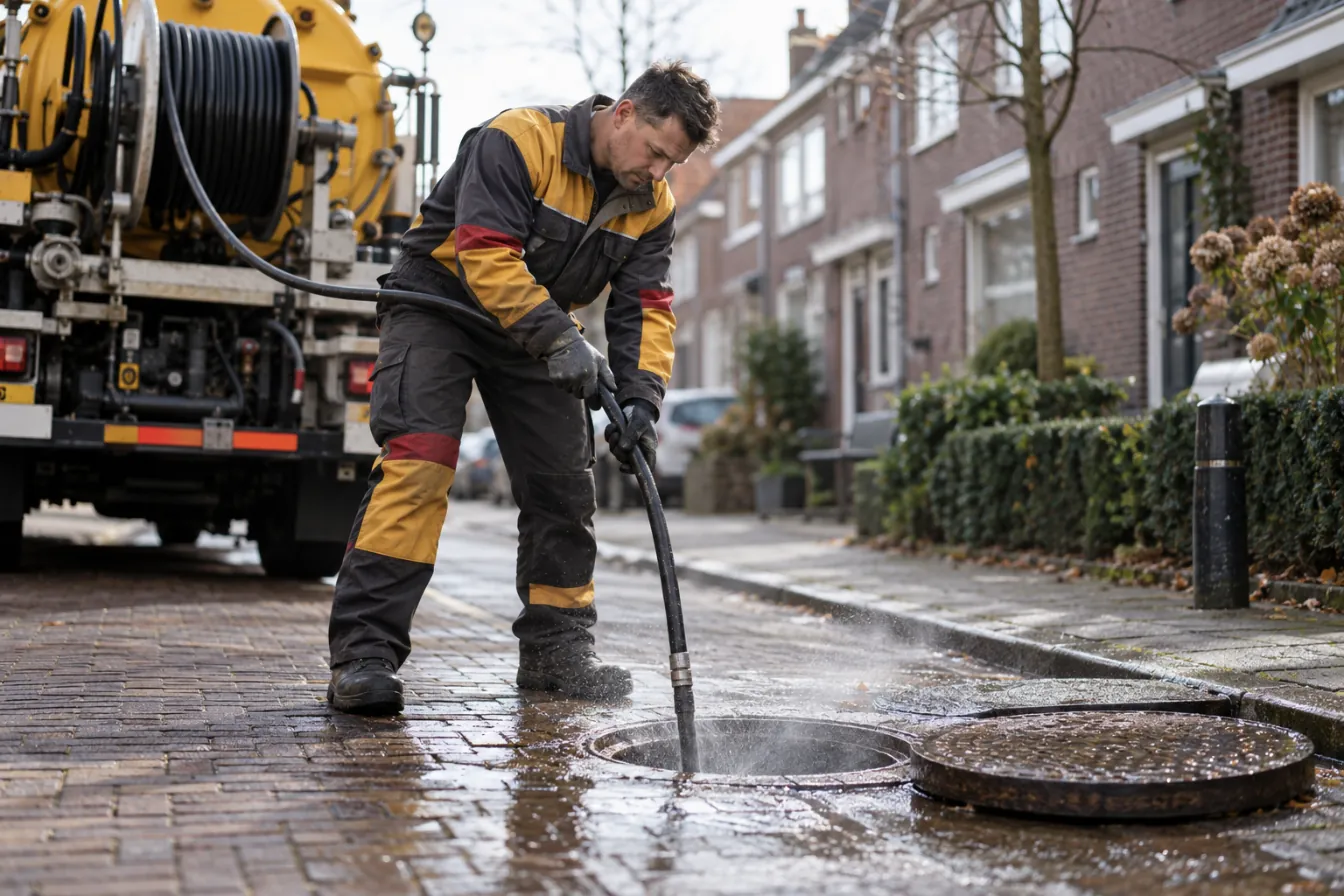
High-pressure sewer jetting means feeding a hose with a jetting nozzle into the pipe. The nozzle's holes spray backwards at an angle, so it pulls itself along the pipe and flushes the dirt back out. The engineer usually works from the inspection chamber, first towards the street and then back towards the house. If the pipe is completely blocked, sewer unblocking comes first: a rotating head or a drain snake opens up a passage, and the cleaning follows.
Cutting through roots and hard deposits
Water alone isn't always enough against roots and hardened grease. In that case, the engineer uses a root cutter or chain flail to knock roots and crusts off the pipe wall, then flushes everything away. Roots grow back as long as the opening in the pipe is there, so we'll also advise you on repairing the joint.
Checking the result
Afterwards, we run plenty of water through the pipe and check in the inspection chamber that it's flowing freely. If there was any doubt about the state of the pipe, a camera inspection follows. We then tell you what we found and what most likely caused it.
What sewer cleaning costs
Our prices start from €129, and the call-out charge comes on top of that. For work in the evening, at night, at the weekend or on a public holiday, we charge the out-of-hours rate.
Cleaning a long stretch of sewer, cutting out roots or combining the work with a camera inspection is priced individually, so for jobs like these just ask for a quote. You'll always get a price estimate over the phone first, and the engineer won't start until you've agreed.
Preventing backflow and keeping the pipe clean
With a combined sewer system, rainwater and waste water share the same pipe. In a cloudburst, the public sewer can fill up so much that water is forced back towards the lowest drains in your home, such as those in a cellar, a basement flat or a ground-floor shower. A non-return valve in that drain prevents this. To keep the pipe itself clean:
- pour fat and oil into a jar, put the lid on and throw it in the general waste;
- put wipes, kitchen roll and cat litter in the bin, never down the toilet;
- don't plant trees or large shrubs right above the sewer pipe;
- keep the leaf guard at the bottom of the downpipe clean, so sand and leaves don't wash into the sewer;
- have an old garden sewer near trees cleaned regularly, just as you would the pipes from a commercial kitchen.
If the downpipe also overflows in heavy rain, or water bubbles up at its base, the blockage is often in the rainwater drain itself. Our page on downpipe unblocking explains more.
Emergencies and service area
Sewage in your home can't wait until Monday. If it's coming up through a drain or the toilet, it's not just unpleasant but unhygienic too. Our sewer service is available day and night on 085 333 4698, Sundays and public holidays included, and the engineer is usually with you within the hour.
We carry out sewer cleaning in Rotterdam, Den Bosch, Enschede and Apeldoorn, among other places, and we clean sewers elsewhere in the Netherlands too; the page on our service area covers a number of cities in more detail. The best approach depends on the address: the soil type, the age of the neighbourhood and the trees in the street all play a part.
Rates per job
Before the engineer sets off, we'll give you a price estimate. If more turns out to be needed on site, we'll discuss it with you first.
Call-out charge not included.
Sewer cleaning: questions and answers
Who is responsible for the sewer, me or the municipality?
Generally speaking, as the owner you're responsible for the drains on your own property, and the municipality for the part under public land. Exactly where that line is drawn varies between municipalities; often it's the property boundary or an inspection chamber close to it. If you rent, the landlord usually deals with the sewer. We can help you work out which side of the line the blockage is on.
How often should a sewer be cleaned?
An ordinary home with no problems doesn't need a fixed schedule. It's a different story with an old garden sewer near trees, a restaurant kitchen or a building with long shared pipes. There, regular cleaning stops grease and roots gradually closing up the pipe. After a camera inspection, we can advise on how often cleaning makes sense in your situation.
Can high-pressure jetting damage my sewer?
A pipe in good condition can easily withstand high pressure; that's what the technique was designed for. With an old clay pipe that's cracked or has a loose joint, the engineer adjusts the pressure and the nozzle. If there's any doubt about the state of the pipe, the camera goes in first. That way the pipe is never put under more strain than it can take.
Do tree roots come back after they've been cut out?
Yes, as long as the opening in the pipe is still there. Cutting clears the pipe, but the crack or open joint the roots got in through remains. That's why, after cutting, we like to show you camera footage of that spot where possible. You can then have the repair done in exactly the right place, instead of digging up the whole garden.
How much does sewer cleaning cost?
The price depends on the length of the pipe, how easy the inspection chamber is to reach and whether roots need cutting out. Our rates start from €129 (call-out charge not included), with an out-of-hours rate in the evening, at night and at weekends. For a larger cleaning job, ask for a quote. Either way, you'll always get a price estimate before the engineer starts.
Still have a question? Have a look in our FAQ section.
More drain unblocking services
-
Drain unblocking service
Blockages in a toilet, kitchen, bathroom or sewer each need a different approach. As a drain unblocking company, we use drain snakes, high-pressure jetting and cameras, depending on the situation.
-
Toilet unblocking
The blockage could be in the bowl, the soil stack or the underground drain. We find out where the toilet is blocked first, then clear the drain thoroughly.
-
Kitchen sink unblocking
Grease, coffee grounds and food scraps slowly build up in the kitchen waste pipe until it blocks. We clear the sink and the pipe behind it, and flush it through with high-pressure jetting where needed.
-
Washbasin unblocking
Hair and soap residue build up in the washbasin trap and waste pipe. We clean both and find out why the basin was slow to drain.
-
Shower drain unblocking
Hair and soap scum build up in the shower drain and the pipe below it. We remove the blockage and clean the pipe along its full length.
-
Drain camera inspection
Recurring blockages always have a cause. A drain camera inspection lets you see live whether roots, subsidence or a broken pipe is to blame.
-
Downpipe unblocking
Leaves, moss and sand block the gutter, the downpipe or the pipe underground. We clear the whole route, so rainwater drains away again instead of running down your walls.
Blocked drain? We'll sort it.
Call now for professional drain unblocking. Price estimate up front, available 24/7, throughout the Netherlands.